
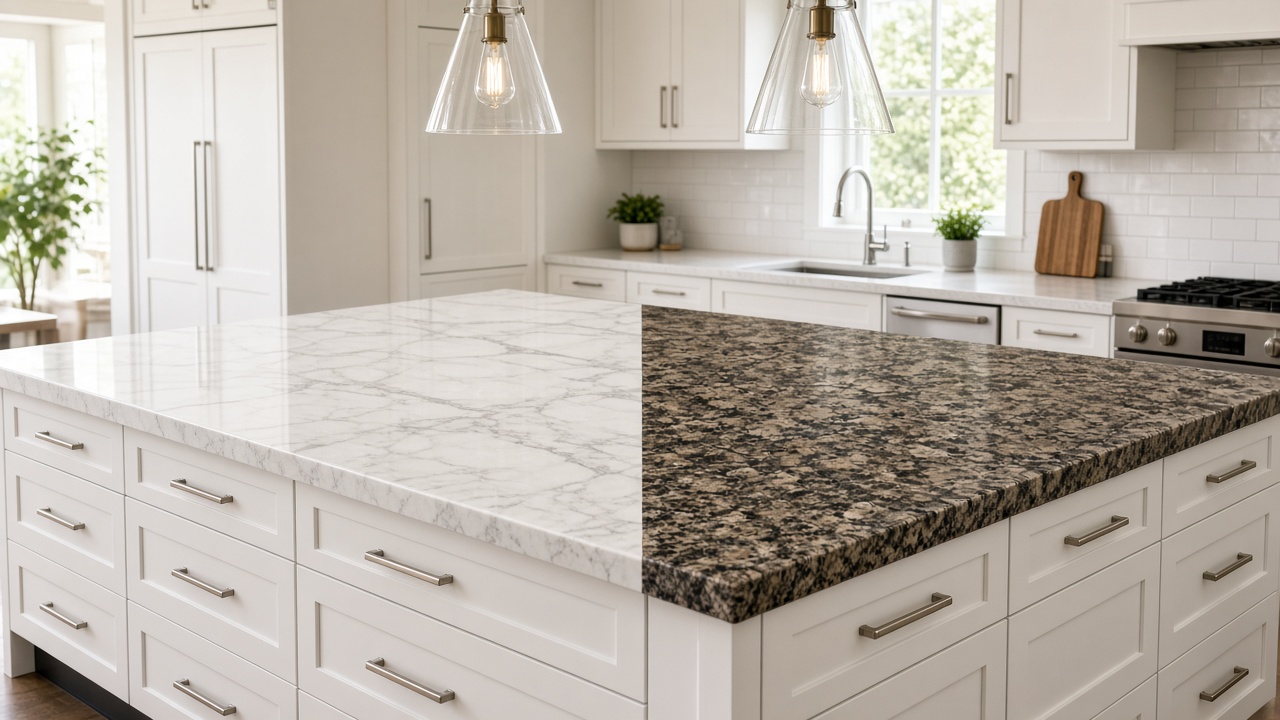
Quartz and granite can both make a durable kitchen counter in a Northern Virginia home, but they ask for different care. Quartz brands sold at Synergy Cabinets, including Cambria and MSI, describe their slabs as nonporous and say they do not need sealing; those same manufacturers tell you to keep hot pans on a trivet. Granite is a natural stone with one-of-a-kind patterning. The Natural Stone Institute says most granite countertops do not need to be sealed, though a quality sealer can make the stone more stain resistant. The surest way to choose is to compare actual slabs in the Annandale showroom before you request a quote.
Key takeaways
- Quartz is an engineered surface. Cambria and MSI both say it never needs sealing or polishing, and both warn against setting hot cookware directly on the top.
- Granite is natural stone. The Natural Stone Institute’s sealing statement is that most granite countertops do not need to be sealed, and that a quality sealer, if you use one, is described with a life expectancy of 10 to 15 years. The Institute’s care guide says a sealer used in a food-preparation area should be made for that use.
- In Fairfax County, replacing kitchen countertops is listed among residential work that does not require a Land Development Services permit, but moving or adding plumbing, or a broader kitchen renovation, can still trigger a permit.
- Synergy Cabinets stocks Cambria, MSI, and Spectrum quartz as well as granite, so you can compare the two materials in one showroom at 7408 Little River Turnpike Service Rd, Annandale, VA 22003.
- Exact pricing depends on the design, thickness, edge, cutouts, and layout. For a brand-by-brand look at the quartz lines we carry, see our Cambria vs MSI vs Spectrum quartz guide. A final figure comes after a quote.
Quartz vs granite at a glance
The table below summarizes the differences that matter in a working kitchen. Care points are taken from manufacturer pages and the Natural Stone Institute, opened on November 11, 2026. They are general rules, not a warranty.
| Question | Quartz | Granite | Where this comes from |
|---|---|---|---|
| What is it? | An engineered slab made with natural quartz and binders | A natural igneous stone, cut and finished as a slab | Manufacturer product-care language; stone-industry care guides |
| Does it need sealing? | No. Cambria and MSI say do not apply sealers | Often no. The Natural Stone Institute says most granite countertops do not need to be sealed; sealing can add stain resistance, not stain-proofing | Cambria Product Care; MSI Q Care & Use; Natural Stone Institute sealing statement |
| Hot pans | Use a closed-weave hot pad or solid trivet. Sudden or sustained heat, especially near edges and cutouts, can damage the surface | Natural stone can handle heat better than many people expect, but the Natural Stone Institute still recommends trivets or mats | Same Cambria and MSI care pages; Natural Stone Institute care guide |
| Stains and everyday cleaning | Nonporous and nonabsorbent, per Cambria; clean with warm water, a soft cloth, and mild soap if needed | Clean with a neutral cleaner or mild dish soap and warm water; blot spills, do not spread them. Avoid acids and cleaners that contain hydrofluoric acid | Cambria Product Care; Natural Stone Institute care guide |
| Appearance | Color and pattern are designed in the factory, so a sample is a close guide to the installed look. Seams are still visible | Each slab is unique. Expect more variation from the sample to the full slab | Cambria Product Care (samples, seams); natural-stone character |
| Where to compare them in Northern Virginia | Cambria, MSI, and Spectrum quartz in the Annandale showroom | Granite slabs and samples in the same showroom | Synergy Cabinets countertops |
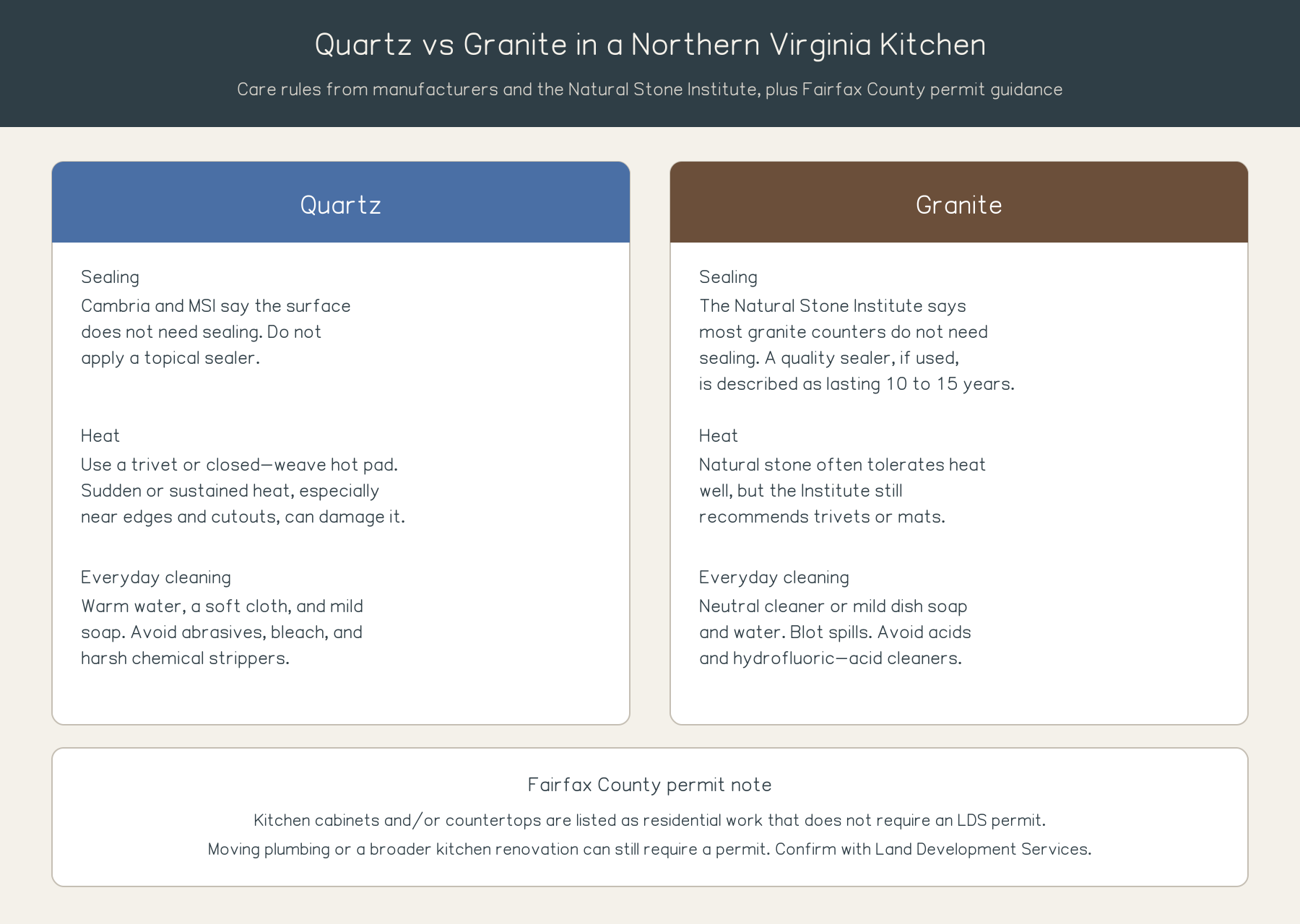
What is the difference between quartz and granite?
Granite is a natural stone. It is quarried, cut into slabs, and polished or finished for use as a countertop. No two slabs are identical, which is the main reason homeowners pick it: the color, flecking, and movement in the stone are unique. That also means the small sample you like in a showroom may not show every “birth mark” in the full slab. The Natural Stone Institute notes that many granite slabs receive a resin treatment at the factory to fill minor fissures and indentations, and that both resined and unresined slabs are long-lived materials when they are cared for as stone.
Quartz countertops are engineered. Manufacturers combine natural quartz with pigments and binders and form the mix into slabs. Cambria describes the result as nonporous and nonabsorbent, which is why it says the surface does not need to be sealed. The visual range is wide, including marble-look designs, but the pattern is created in production rather than found in a quarry. Seams are still part of a real kitchen layout. Cambria states plainly that the product is not seamless and that pattern and shade can change across a seam.
If you already know you want quartz and are choosing among brands, stop here and use the Cambria vs MSI vs Spectrum comparison. The rest of this guide is about choosing the material itself.
Does granite need to be sealed?
Most granite countertops do not need to be sealed. That is the Natural Stone Institute’s published statement of position, not a marketing slogan. The Institute also says that if a homeowner cleans the counters after each meal, staining and cleanability problems with granite are uncommon, and that it is not aware of food-safety or radon problems tied to treated or untreated granite in that statement. Many counters still receive a sealer as an extra precaution. In that case the Institute’s care guide says the product should be a quality impregnating sealer suitable for food-preparation areas. The Institute’s sealing statement describes a quality sealer as oliophobic (resistant to water- and oil-based stains) and as having a life expectancy of 10 to 15 years. Sealing makes stone more stain resistant. It does not make the stone stain-proof.
That official position is more cautious than the shorthand many websites use, including a short note on our own countertops page that mentions resealing granite on a short cycle. Follow the stone supplier’s and sealer manufacturer’s instructions for the actual slab you buy, and use the Natural Stone Institute guidance as the industry baseline.
A simple water test is often used in shops: if a few drops sit on the surface and darken the stone, a sealer may help; if they bead up, the surface is already resisting moisture. Treat that as a field check, not a laboratory result, and ask the person quoting your job how your chosen slab was finished.
Can you put a hot pan on quartz or granite?
You should not set a hot pan, griddle, slow cooker, air fryer, or similar appliance directly on a quartz countertop. Cambria’s product-care page says Cambria is not heat-proof, and it recommends a closed-weave hot pad or a solid trivet, such as a breadboard, under hot cookware and heat-producing appliances. Sudden or rapid temperature changes near edges, and prolonged heat on the surface, can damage the top. MSI’s official Care & Use sheet for Q Premium Natural Quartz gives the same practical rule: always use a trivet or hot pad between the counter and any heat-generating device. It warns that a sudden or rapid temperature change, or sustained heating, especially near edges and cutouts, can create enough thermal expansion to crack the slab, and that this kind of damage is not covered under the Q warranty.
Granite is natural stone, and many people choose it in part because it tolerates heat well. Even so, the Natural Stone Institute’s care guide says that while many stones can withstand heat, trivets or mats are still recommended. Using one costs nothing and protects edges, seams, and any resin-filled areas in the slab.
In short: plan on trivets for either material. Quartz manufacturers are explicit that direct or sustained heat is a known risk. Granite is generally more forgiving, but it is still a finished counter, not a stovetop.
How do you clean quartz and granite?
For quartz, keep the routine simple and stay away from the wrong chemicals. Cambria recommends warm water, a soft cotton cloth, and mild soap if you want it, and it tells owners not to use bleach, oven cleaners, abrasive powders or pads, or any sealer or topical treatment. MSI’s care sheet allows everyday cleaning with a soft sponge or dishcloth and warm water, and a gentle liquid cleaner or dishwashing detergent for greasy spots. It warns against abrasive powders such as regular Comet or Ajax, against red or green Scotch-Brite pads, and against drain cleaners, paint strippers, hydrofluoric acid, methylene chloride, trichloroethylene, or very high- or very low-pH products.
For granite and other natural stone, the Natural Stone Institute recommends a neutral cleaner, stone soap, or a mild liquid dishwashing detergent and warm water, then a thorough rinse and a dry soft cloth. Blot spills; wiping can spread them. Use coasters under glasses, especially drinks with alcohol or citrus. Skip lemon, vinegar, and other acids on calcareous stone, and never use a rust remover or toilet-bowl cleaner that contains hydrofluoric acid: the Institute says that acid attacks silicates and will damage granite. Do not mix ammonia and bleach.
If a stain has already set in natural stone, the Institute’s care guide walks through oil-based, organic, metal, and other stain types and when to call a stone professional. Do not improvise with harsh chemicals on a finished island.
Which surface looks right in a Northern Virginia kitchen?
Choose granite if you want a slab that could not be copied, and you are willing to pick that slab in person. Movement, flecks, and color shifts are the point. Plan time in the showroom to see a larger piece than a four-inch sample, and ask how the fabricator will lay out seams on your island or L-shaped run.
Choose quartz if you want a consistent, designed look (including many marble-look patterns), and you want a surface the manufacturer describes as nonporous and that does not need routine sealing. Consistency is not the same as invisibility: seams will still show, and Cambria notes that monotone designs can make small surface marks easier to see.
Color pairings with cabinets are easier to judge in person than on a screen, especially in the mix of natural and recessed light common in Northern Virginia kitchens. If you are still choosing cabinets, start with our kitchen cabinet cost guide for Northern Virginia and browse kitchen cabinets in the same visit so the door style and the counter can be viewed together.
Compare slabs in Annandale. Synergy Cabinets is at 7408 Little River Turnpike Service Rd, Annandale, VA 22003, and is open Monday through Saturday from 9 AM to 6 PM (Sunday closed). Book an appointment or request a quote if you already have measurements and photos.
Do you need a permit to replace countertops in Fairfax County?
In Fairfax County, “Kitchen cabinets and/or countertops” are listed on the Land Development Services page for residential work that does not require a permit. A like-for-like countertop replacement that does not move plumbing, change the layout of the room, or become part of a larger renovation is, on that guidance, work you can plan without an LDS permit.
A permit can still be required if the project goes further. The same official page lists “New, repair or relocated plumbing or gas fixtures” (including sinks) and “Interior alterations/renovations,” which expressly include kitchen renovations, among the residential projects that do require a permit. Direct replacement of existing plumbing, with no change in location and a like-for-like fixture, is listed as not requiring a permit. If you are moving a sink, adding a fixture, opening walls, or treating the work as a kitchen renovation, check with Land Development Services before you start, and apply in the Planning and Land Use System (PLUS) when a permit is required.
This guidance is for Fairfax County, which includes Annandale. The City of Fairfax, the City of Falls Church, and the towns of Vienna, Herndon, and Clifton have their own permit offices. If your home is in Arlington County or the City of Alexandria, use that jurisdiction’s rules instead. When in doubt, ask the local building department, not a showroom blog post, for a final determination.
How should you choose a slab in the showroom?
- Decide which material properties matter most in your kitchen: no routine sealing, a unique natural pattern, heat habits around the range, or a specific marble-look design.
- Look at full slabs or large samples in person, in daylight and under the showroom lights, and bring a cabinet door or a chip of your floor if you already have one.
- Ask how seams, sink cutouts, and cooktop cutouts will fall. Those are the places quartz manufacturers flag for heat and impact risk, and they are also where a granite layout can place a busy or quiet area of the stone on purpose.
- Confirm thickness, edge profile, and backsplash in the quote, item by item.
- If you choose quartz, use our brand comparison to narrow Cambria, MSI, and Spectrum before you buy. If you choose granite, ask how the slab was finished and whether a sealer is recommended for that specific stone.
- Send room measurements, appliance model numbers, and photos with your quote request, or bring them to an appointment.
We do not publish a single project price in this guide. Slab price, thickness, edge detail, the number of cutouts, and layout all change the figure, and a number pulled from a national average would not be your number.
Questions homeowners ask
Is quartz or granite better for a kitchen?
Neither material is “better” in every kitchen. Quartz is usually the lower-maintenance choice because Cambria and MSI say it does not need sealing and is nonporous. Granite is the choice when you want a natural, one-of-a-kind slab and are comfortable with stone care, including the Natural Stone Institute’s guidance on cleaning and optional sealing. Compare both in person and match the surface to how you cook, clean, and live in the room.
Do quartz countertops need to be sealed?
No. Cambria states that its quartz never requires sealing, polishing, or reconditioning, and that you should not apply sealers or topical treatments. MSI’s Care & Use sheet says there is no need to seal Q Premium Natural Quartz, because a sealer cannot penetrate the surface and can wear off unevenly. Clean with warm water and a soft cloth; add mild soap if you need it.
How often should granite be sealed?
There is no single calendar interval that applies to every granite slab. The Natural Stone Institute says most granite countertops do not need to be sealed, and that when a quality sealer is used it should have a life expectancy of 10 to 15 years. Follow the supplier’s and sealer manufacturer’s instructions for your slab rather than a generic “every few years” rule.
Which is more heat resistant, quartz or granite?
Granite, as a natural stone, is generally more tolerant of heat, but trivets are still recommended. Quartz manufacturers are clear that the surface is not heat-proof. Cambria and MSI both tell you to use a hot pad or trivet, and MSI warns that sudden temperature change or sustained heating near edges and cutouts can crack the slab. Use a trivet on either surface, especially next to the range.
Do I need a permit to replace kitchen countertops in Annandale?
Annandale is in Fairfax County. Fairfax County Land Development Services lists “Kitchen cabinets and/or countertops” among residential work that does not require a permit, so a like-for-like countertop replacement typically does not. A permit may still be required if you relocate plumbing or if the work is part of a kitchen renovation. Confirm with LDS if your scope is larger than a surface replacement, and use a different official source if your home sits in an independent city or town.
Where can I see quartz and granite in Northern Virginia?
You can compare Cambria, MSI, and Spectrum quartz and granite at Synergy Cabinets, 7408 Little River Turnpike Service Rd, Annandale, VA 22003. The showroom is open Monday through Saturday from 9 AM to 6 PM and is closed on Sunday. Call (703) 673-2229, request a quote, or book an appointment.
Visit the Annandale showroom
If you are choosing between quartz and granite, the decision gets easier when the slabs are in front of you. Synergy Cabinets is a cabinet and countertop store at 7408 Little River Turnpike Service Rd, Annandale, VA 22003. We are open Monday through Saturday from 9 AM to 6 PM, and we are closed on Sunday. Call (703) 673-2229, request a quote, or book an appointment. Bring measurements, appliance model numbers, and a few photos of the kitchen if you have them.
Sources (opened November 11, 2026): Natural Stone Institute, Statement of Position on Sealing Natural Stone Countertops; Natural Stone Institute, Care & Cleaning of Natural Stone; Cambria Product Care; MSI Q Premium Natural Quartz Care & Use; Fairfax County Land Development Services, Does My Project Require a Permit?; Fairfax County Codes and Standards.