
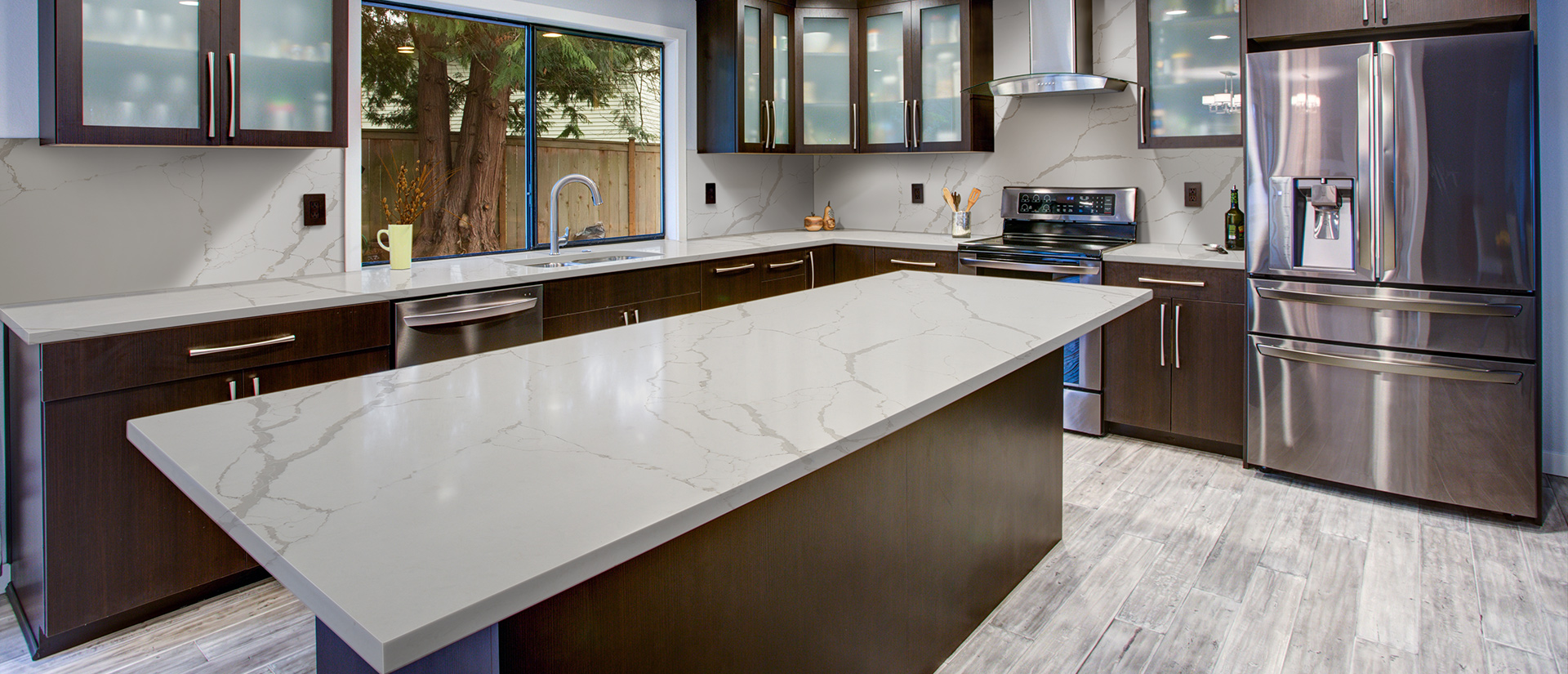
Choosing quartz is the easy part. Choosing the right quartz brand is where most homeowners get stuck. Walk into any countertop showroom in Northern Virginia and you will see hundreds of white, gray and marble-look slabs that seem nearly identical — yet one brand may cost noticeably more than another for a countertop that looks very similar from across the room.
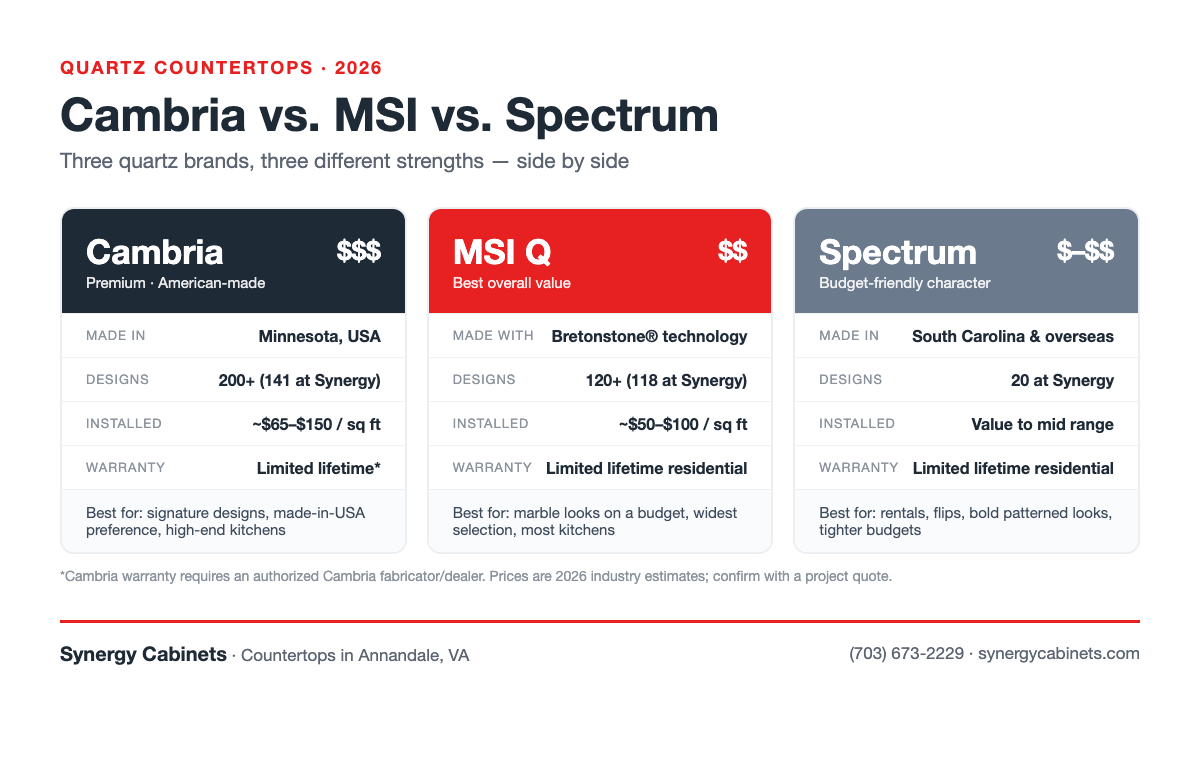
At our Annandale showroom we carry three quartz brands side by side: Cambria, MSI Q Premium Natural Quartz and Spectrum Quartz. Between them, our product catalog includes more than 270 quartz designs. This guide compares the three honestly — where each is made, how they differ in design and price, what their warranties cover, which colors are most popular, and which brand makes sense for your kitchen and budget.
Quick Answer: Which Quartz Brand Should You Choose?
- Choose Cambria if you want American-made quartz, distinctive signature designs and a premium brand name — and your budget has room for it. Expect roughly $65–$150+ per square foot installed.
- Choose MSI Q if you want the best balance of price, selection and marble-look realism. Expect roughly $50–$100 per square foot installed. For most kitchens, this is the value sweet spot.
- Choose Spectrum if you want an affordable quartz with character — bold patterns, movement and texture — for a family kitchen, rental or flip. Pricing is typically at or below MSI, depending on the design.
- All three are non-porous engineered quartz that never needs sealing, and all three offer a limited lifetime residential warranty under their respective terms.
- What all quartz brands have in common
- Cambria: premium American-made quartz
- MSI Q Premium Natural Quartz: the value leader
- Spectrum Quartz: budget-friendly character
- Head-to-head comparison
- Cost comparison for real kitchens
- Best marble-look quartz from each brand
- Pairing quartz with your cabinets
- Thickness, edges and seams
- Care and maintenance
- Common mistakes to avoid
- Which brand is right for you?
- FAQ
What All Quartz Brands Have in Common
Before comparing brands, it helps to know what you are actually buying. Engineered quartz countertops are made by combining crushed natural quartz — typically around 90% or more of the material — with polymer resins and pigments, then compacting and curing the mixture into slabs. The result is a hard, dense, non-porous surface. That basic recipe is the same for Cambria, MSI and Spectrum, which is why all three share the same core benefits:
- No sealing required. Unlike granite and marble, quartz is non-porous, so it resists staining from coffee, wine and oils without periodic sealing.
- Consistent appearance. Because slabs are engineered, the color and pattern you choose from a sample will closely match your installed countertop.
- Hygienic surface. The non-porous finish does not harbor bacteria in pores the way some natural stones can.
- Durability. Quartz is highly scratch- and chip-resistant in normal kitchen use.
They also share the same limitations, which no brand can fully engineer away:
- Heat sensitivity. The resin in quartz can discolor or crack under direct high heat. Always use trivets for hot pans and slow cookers.
- Not for outdoor use. Prolonged UV exposure can cause fading or yellowing, so quartz manufacturers generally do not recommend it for outdoor kitchens.
- Seams are visible on long runs. Slabs have maximum sizes, so large islands and L-shaped counters may require seams; skilled fabrication makes them far less noticeable.
So the differences between brands come down to design quality and variety, manufacturing origin, consistency, warranty terms, availability and price. Here is how each brand stacks up.
Quartz vs. granite vs. marble: why quartz wins for most kitchens
Many homeowners start their search undecided between quartz and natural stone. Each material has a place, but for busy Northern Virginia households quartz usually comes out ahead on maintenance and consistency.
| Quartz | Granite | Marble | |
|---|---|---|---|
| Sealing | Never | Periodically | Regularly |
| Stain resistance | Excellent | Good when sealed | Poor — etches with acids |
| Heat resistance | Use trivets | Very good | Good |
| Pattern consistency | Very consistent | Every slab unique | Every slab unique |
| Outdoor use | Not recommended | Yes | Limited |
| Maintenance | Lowest | Low to moderate | Highest |
| Best for | Busy family kitchens, marble look without upkeep | Natural one-of-a-kind look, heat-heavy cooking | Bakers and purists who accept patina |
If you love the idea of natural stone, our granite collection is organized into price groups from A to D. But if what you really want is the look of marble without the etching, quartz is the practical answer — and that is where choosing the right brand matters.
Cambria: Premium American-Made Quartz
Cambria is a family-owned company founded in 2000 and headquartered in Le Sueur, Minnesota, where it also manufactures its slabs. Cambria is one of the very few quartz brands produced in the United States, and the company emphasizes vertical integration — controlling its raw materials, manufacturing and quality control. Its design library includes more than 200 designs, and our Synergy catalog lists 141 Cambria designs.
What makes Cambria different
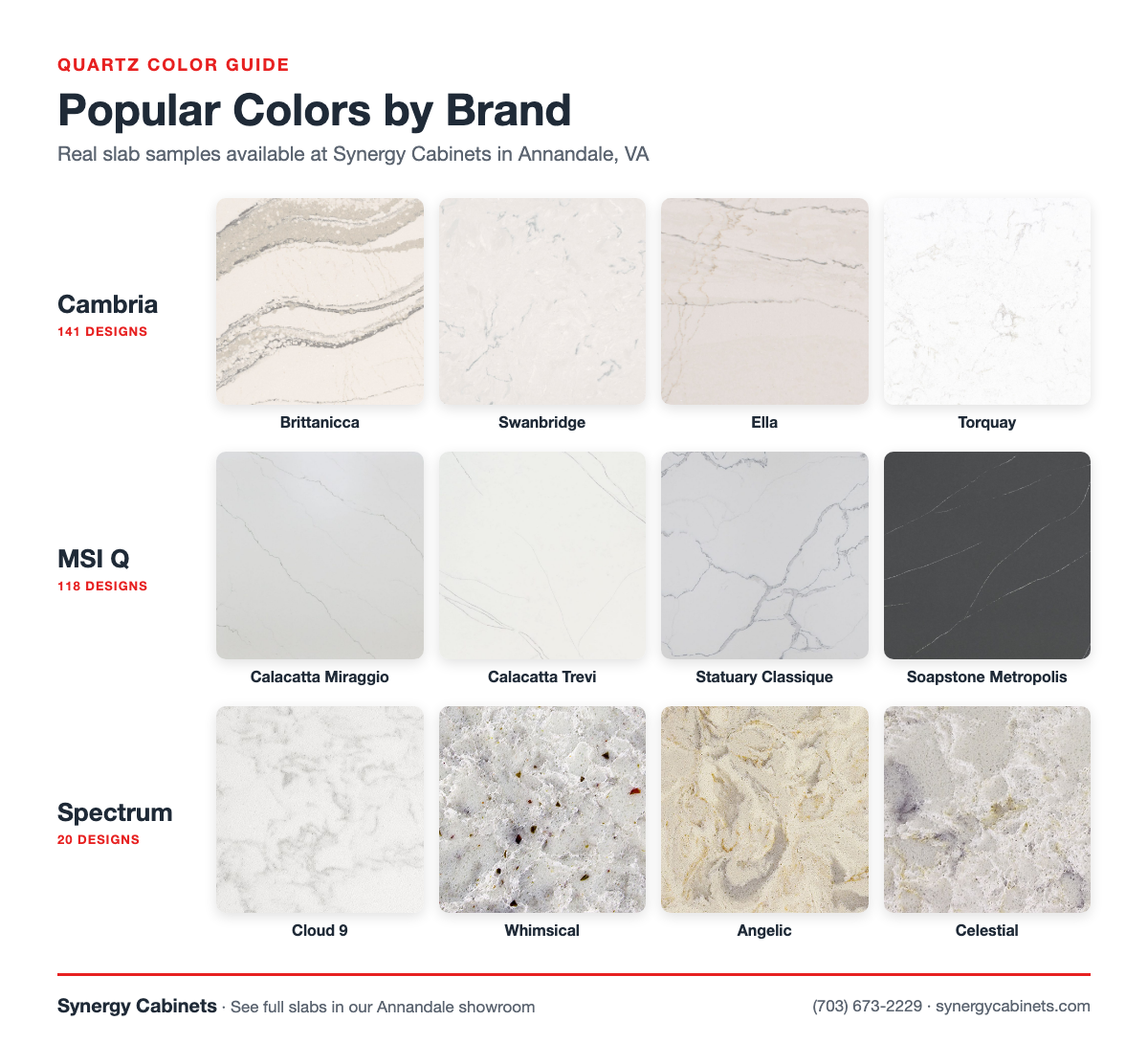
- Signature designs. Cambria is known for dramatic, flowing veining and patterns that are distinctive to the brand. Designs like Brittanicca, with its sweeping gray and taupe waves across a warm white background, are instantly recognizable.
- American manufacturing. For homeowners who prioritize buying domestically made products, Cambria is the clearest choice among the three.
- Controlled distribution. Cambria is sold and installed through authorized dealers and fabricators, and its limited lifetime residential warranty depends on installation through that network.
- Finish options. Many designs are offered in high-gloss and matte finishes.
Popular Cambria designs at Synergy
| Design | Look | Pairs Well With |
|---|---|---|
| Brittanicca | Warm white with bold, sweeping gray and taupe waves | White or greige Shaker cabinets; statement islands |
| Swanbridge | Soft white with fine gray marble-like veining | Navy, sage or black cabinets |
| Ella | Creamy warm white with soft linear taupe veins | Wood tones and warm whites |
| Torquay | Bright white with subtle gray flecks | Any cabinet color; clean, low-key look |
Cambria pros and cons
✔ Pros
- Made in the USA (Minnesota)
- Distinctive, recognizable designs
- Large design library
- Limited lifetime residential warranty through authorized installers
- Strong brand recognition at resale
✘ Cons
- Highest price of the three — often 20–40% more than comparable imported quartz
- Must be fabricated by authorized partners for warranty coverage
- Like all quartz, sensitive to direct heat and UV
Explore the full collection on our Cambria quartz countertops page.
MSI Q Premium Natural Quartz: The Value Leader
MSI is one of the largest distributors of surfaces in North America, and Q Premium Natural Quartz is its quartz line. According to MSI, Q quartz is made using advanced manufacturing techniques including the Bretonstone® system, offers more than 120 design choices, and carries a Limited Lifetime Residential Warranty along with a 10-year commercial warranty. Our catalog lists 118 MSI quartz designs.
What makes MSI Q different
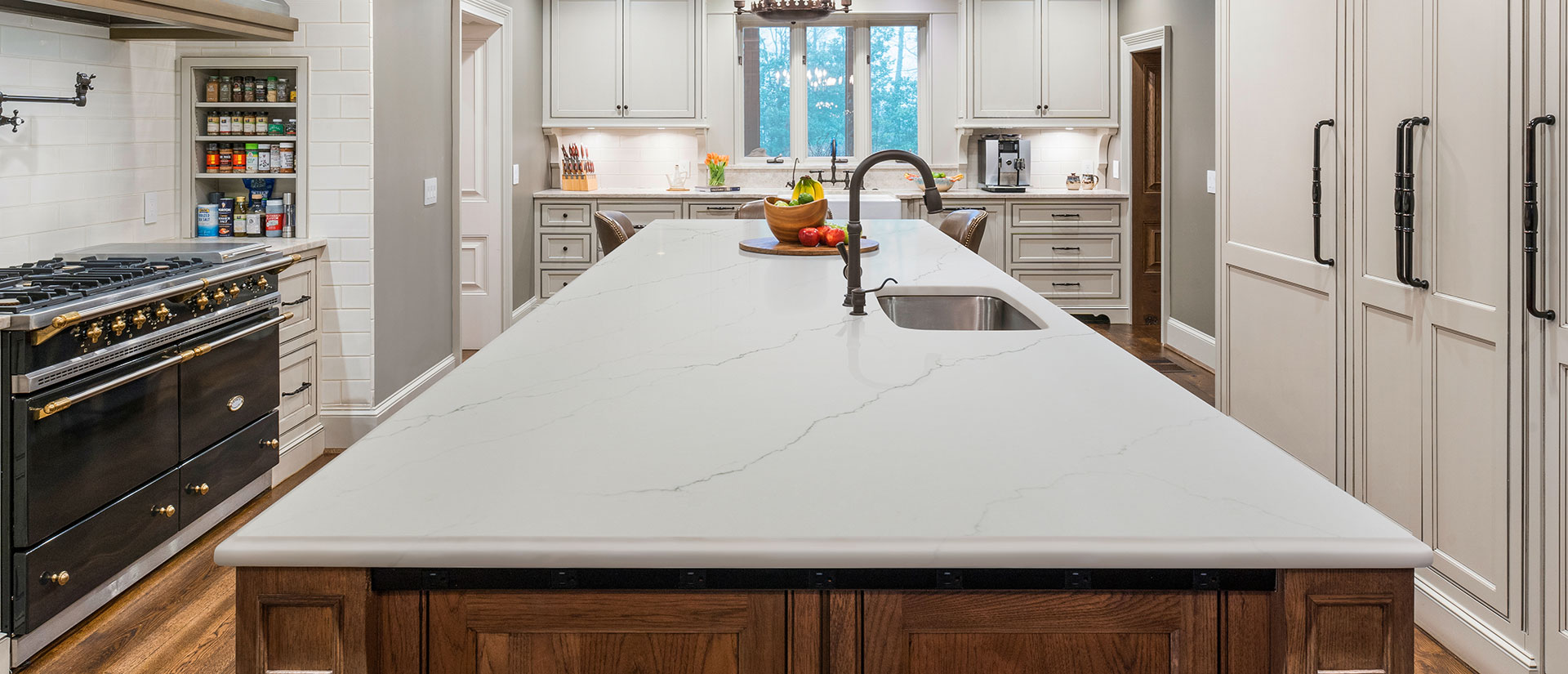
- Price-to-look ratio. MSI is best known for realistic marble-look quartz — Calacatta, Carrara and Statuary styles — at prices that fit mid-range budgets.
- Huge, trend-driven selection. MSI releases new designs frequently, including warm-veined Calacattas, soapstone looks and concrete looks.
- Availability. MSI’s large distribution network means popular colors are widely stocked, which helps keep project timelines short.
Popular MSI Q designs at Synergy
| Design | Look | Pairs Well With |
|---|---|---|
| Calacatta Laza | White with gray and gold-toned Calacatta veining | White, cream and wood cabinets; brass hardware |
| Calacatta Miraggio | Soft white with thin, elegant gray veins | Almost any cabinet color |
| Calacatta Trevi | Bright white with fine, delicate veining | Modern and transitional kitchens |
| Statuary Classique | Cool white-gray with bold, branching gray veins | Navy, black and gray cabinets |
| Carrara Marmi | Classic Carrara-style soft gray veining | Traditional white kitchens |
| Frost White & Arctic White | Clean, minimal whites | Busy backsplashes; modern slab doors |
| Soapstone Metropolis | Charcoal with fine white veining | White or light wood cabinets; farmhouse kitchens |
MSI Q pros and cons
✔ Pros
- Excellent price for realistic marble looks
- Very wide, trend-focused selection
- Limited lifetime residential warranty
- Widely available — shorter timelines
✘ Cons
- Not made in the USA
- With so many similar whites, choosing can be overwhelming — see slabs in person
- Like all quartz, sensitive to direct heat and UV
Browse more on our MSI quartz countertops page.
Spectrum Quartz: Budget-Friendly Character
Spectrum Quartz has been producing quartz surfaces for more than a decade, with slabs crafted domestically in South Carolina and overseas, according to the company. Spectrum highlights its Rift Vein™ technology, designed to mimic the way natural stone fractures, and its very bright white pigment. Its residential warranty is a limited lifetime warranty for the original owner. Our catalog includes 20 Spectrum designs.
What makes Spectrum different
- Personality. Where many brands focus on quiet whites, Spectrum’s lineup includes bolder patterns, swirls and speckled textures that give a kitchen more character.
- Value. Spectrum is generally an affordable option, which makes it popular for rentals, flips, basements and budget-conscious family kitchens.
- Forgiving surfaces. Patterned and speckled quartz hides crumbs, water spots and everyday wear better than solid whites.
Popular Spectrum designs at Synergy
| Design | Look | Pairs Well With |
|---|---|---|
| Cloud 9 | White with soft gray marbling | White, gray or blue cabinets |
| Whimsical | Gray-white with speckles and dark accents — a granite-like look | Wood or espresso cabinets |
| Angelic | Cream and gold with flowing swirls | Warm wood and cream cabinets |
| Celestial | Light gray with soft lavender-gray swirls | White and gray cabinets |
Spectrum pros and cons
✔ Pros
- Affordable pricing
- Distinctive patterns with movement
- Hides everyday wear well
- Limited lifetime residential warranty
✘ Cons
- Smaller selection than Cambria or MSI
- Fewer ultra-realistic Calacatta looks
- Warranty is for the original owner
See all Spectrum designs on our Spectrum quartz countertops page.
Cambria vs. MSI vs. Spectrum: Head-to-Head Comparison
| Cambria | MSI Q | Spectrum | |
|---|---|---|---|
| Manufacturing | Le Sueur, Minnesota, USA | Bretonstone® technology; imported | South Carolina and overseas |
| Designs (brand) | 200+ | 120+ | Smaller curated line |
| Designs at Synergy | 141 | 118 | 20 |
| Style strength | Signature dramatic veining | Realistic marble looks, trends | Bold patterns and texture |
| Installed price | ~$65–$150+ / sq ft | ~$50–$100 / sq ft | Typically at or below MSI |
| Residential warranty | Limited lifetime (authorized fabricator) | Limited lifetime | Limited lifetime (original owner) |
| Commercial warranty | Ask dealer | 10 years | 10 years |
| Sealing | Not required for any of the three | ||
| Best for | High-end kitchens, made-in-USA buyers | Most kitchens; marble looks on a budget | Rentals, flips, busy family kitchens |
In practice, these brands overlap more than the table suggests. A premium MSI design can approach the price of an entry-level Cambria design, and a simple Spectrum white can look very similar to a mid-range MSI white. That is why we always recommend comparing two or three specific slabs — not just brands — for your project.
Consistency and support matter too. With engineered quartz, the slab delivered to your fabricator should closely match the sample you approved, but dye lots can vary slightly between production runs. Ordering the full quantity for your kitchen at once, and having the fabricator check slabs before cutting, avoids mismatched pieces. It also helps to buy through a showroom that works with the brand regularly: when a question about warranty registration, a seam, or a chipped edge comes up after installation, you want one point of contact who already knows your project rather than a chain of separate suppliers. At Synergy, the same team that designs your cabinets coordinates your countertop templating and installation.
Quartz Countertop Cost Comparison for Real Kitchens
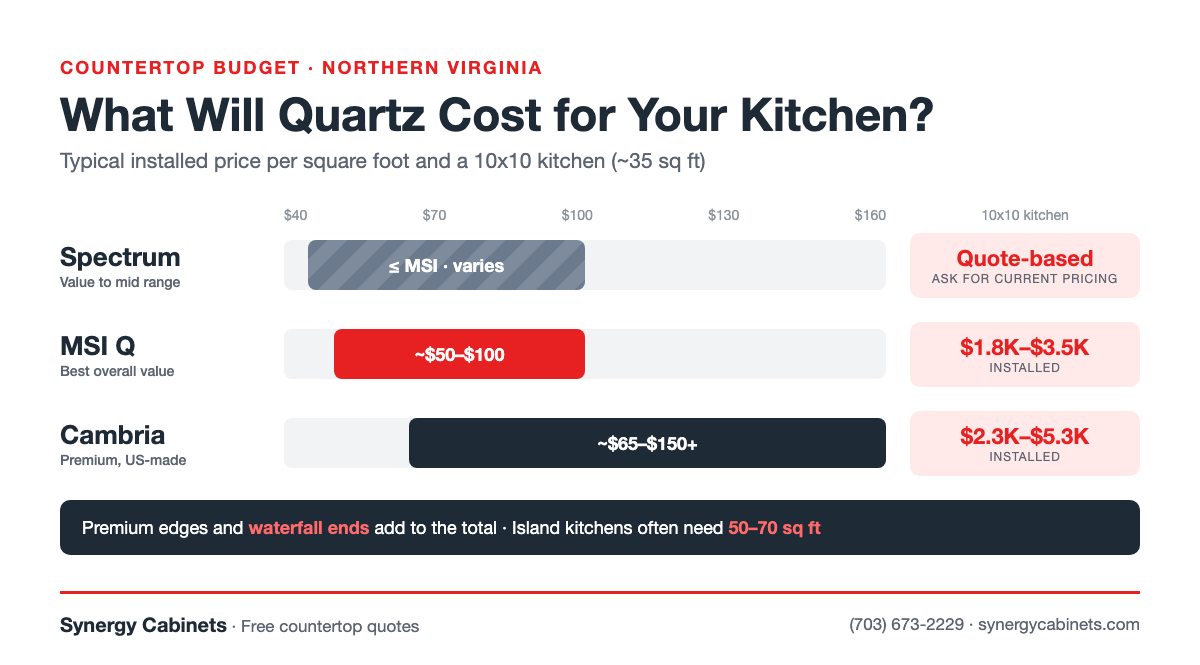
Countertop pricing is based on square footage, plus fabrication details such as edge profiles, sink and cooktop cutouts, and backsplash height. A typical 10×10 kitchen has about 30–40 square feet of countertop, while a kitchen with an island often needs 50–70 square feet.
| Kitchen | Approx. Sq Ft | MSI Q (~$50–$100) | Cambria (~$65–$150) |
|---|---|---|---|
| Condo galley kitchen | 25 sq ft | $1,250 – $2,500 | $1,625 – $3,750 |
| Standard 10×10 L-shape | 35 sq ft | $1,750 – $3,500 | $2,275 – $5,250 |
| L-shape with small island | 50 sq ft | $2,500 – $5,000 | $3,250 – $7,500 |
| Large kitchen with big island | 70 sq ft | $3,500 – $7,000 | $4,550 – $10,500 |
Spectrum pricing varies by design and is typically at or below MSI, so ask us for a current quote on the specific slab you like. Remember that these figures cover countertops only. For a complete kitchen budget including cabinets and installation, see our 2026 kitchen cabinet cost guide for Northern Virginia.
What raises a quartz countertop quote?
- Premium designs. Within each brand, designs are grouped into price levels; dramatic veining and rarer colors cost more.
- Edge profiles. A simple eased edge is standard; ogee, bullnose and mitered edges add fabrication time.
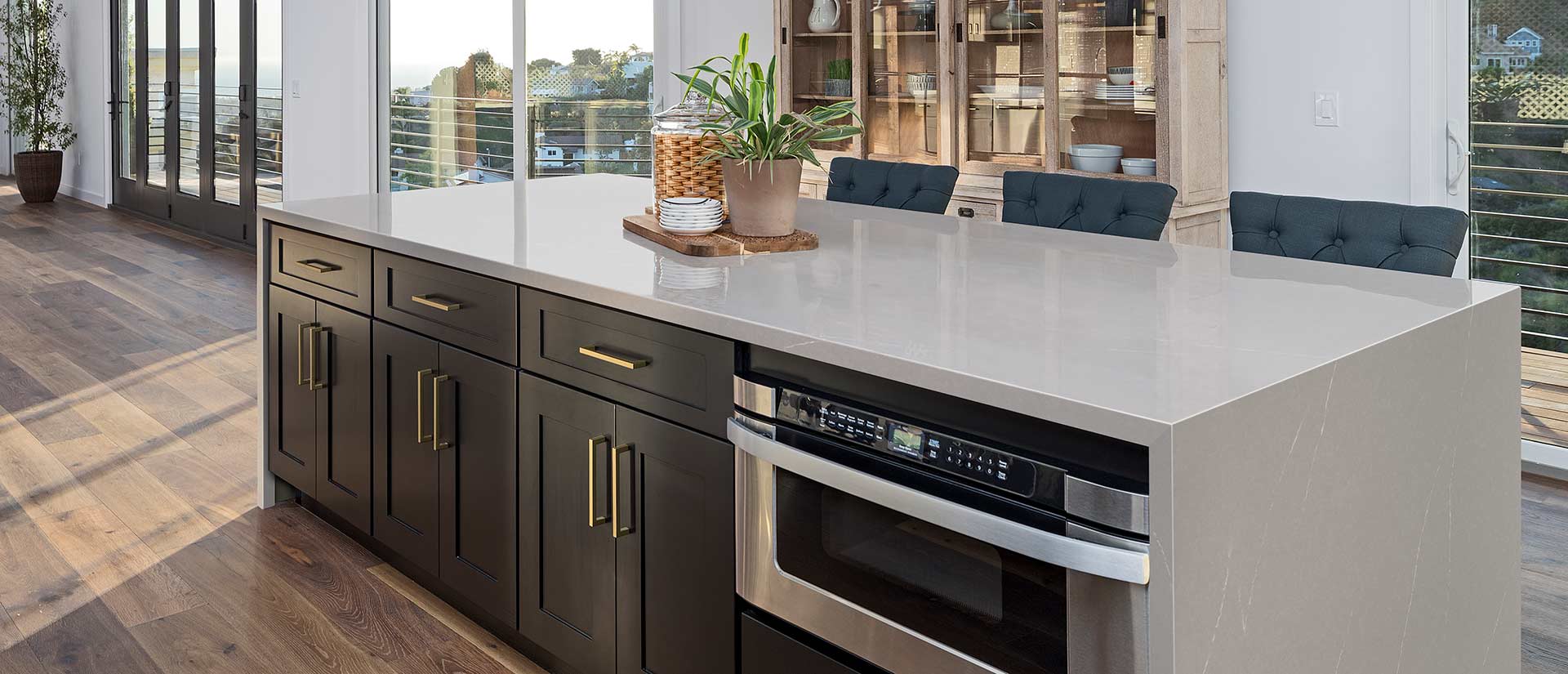
- Waterfall ends. Running the quartz down the side of an island looks stunning but uses more material and requires precise miter work.
- Full-height backsplash. Using a quartz slab for the backsplash instead of tile increases square footage.
- Vein matching. Bookmatching or continuous veining across seams takes extra planning and sometimes extra material.
- Cutouts. Undermount sinks, cooktops and outlet cutouts each add to the fabrication cost.
Three sample quartz budgets
To put these numbers in context, here are three common project types we see across Fairfax County, using the per-square-foot ranges above:
| Condo Refresh | Family Kitchen | Showpiece Kitchen | |
|---|---|---|---|
| Size | ~25 sq ft galley | ~50 sq ft with island | ~70 sq ft, large island |
| Brand & design | Spectrum or entry MSI white | MSI Calacatta-style | Cambria signature design |
| Details | Eased edge, undermount sink | Eased edge, 4″ backsplash | Mitered edge, waterfall end |
| Estimated range | About $1,250 – $2,500 | About $2,500 – $5,000 | About $4,550 – $10,500+ |
The biggest swing factor is not the brand itself but the combination of square footage and the specific design tier. A family kitchen in a mid-tier MSI design and the same kitchen in a top-tier MSI design can differ by more than the gap between MSI and Cambria on simpler designs.
Questions to ask before you sign a countertop quote
- Is the price per square foot or a total for the whole project?
- Does it include templating, fabrication, delivery and installation?
- Are sink, cooktop and faucet cutouts included?
- Which edge profile is included, and what do upgrades cost?
- Where will seams be placed?
- Does the quote include removal and disposal of old countertops?
- How is the manufacturer warranty registered, and who handles claims?
See Cambria, MSI and Spectrum Side by Side
Visit our Annandale showroom to compare real samples and get a free countertop quote with your cabinet design.
Best Marble-Look Quartz From Each Brand
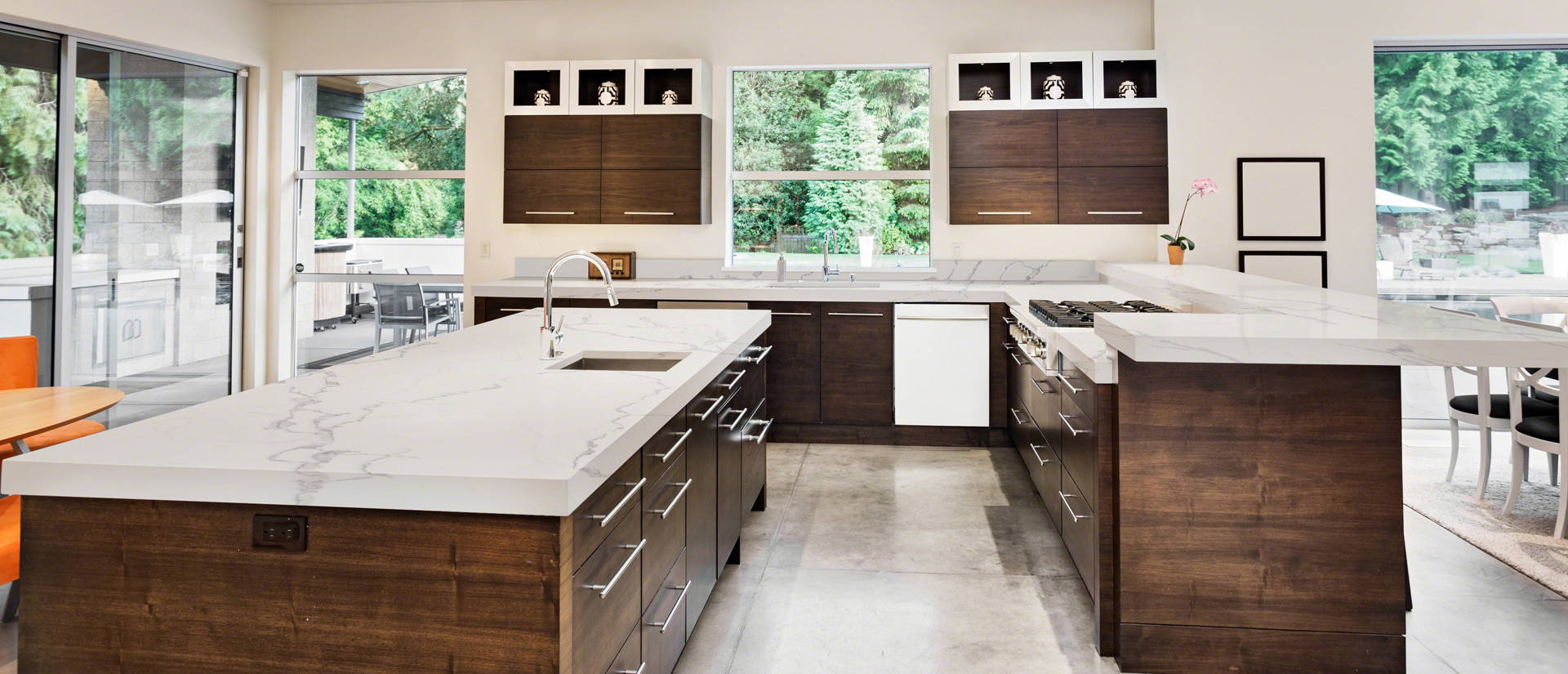
White marble-look quartz is by far the most requested countertop style in Northern Virginia kitchens. It delivers the look of Calacatta or Carrara marble without marble’s etching, staining and sealing. Here is how each brand approaches it:
| Look | Cambria | MSI Q | Spectrum |
|---|---|---|---|
| Bold, dramatic veining | Brittanicca | Statuary Classique | Angelic (warm swirls) |
| Soft, subtle veining | Swanbridge | Calacatta Miraggio | Cloud 9 |
| Warm, creamy tone | Ella | Calacatta Laza | Angelic |
| Clean bright white | Torquay | Calacatta Trevi | Celestial (light gray) |
Pairing Quartz With Your Cabinets
The best countertop choice depends on your cabinets. Because we design cabinets and countertops together, here are combinations that work well with popular cabinet colors — including finishes from our Fabuwood cabinets review.
| Cabinet Color | Recommended Quartz | Why It Works |
|---|---|---|
| Bright white (e.g., Fabuwood Frost) | Calacatta Laza, Brittanicca, Statuary Classique | Veining adds depth so the kitchen does not look flat |
| Warm white / cream (Dove, Linen) | Ella, Calacatta Laza, Angelic | Warm undertones match instead of clashing |
| Navy / indigo | Swanbridge, Calacatta Miraggio, Cloud 9 | Crisp white surface creates classic contrast |
| Sage or green | Calacatta Laza, Ella | Gold or warm veining complements green tones |
| Black or charcoal | Calacatta Trevi, Torquay | Bright white keeps the space from feeling heavy |
| Natural wood | Soapstone Metropolis, Cloud 9, Swanbridge | Dark or cool tones balance warm wood |
| Gray | Statuary Classique, Celestial | Cool veining echoes gray undertones |
Want to preview combinations before visiting? Try our kitchen visualizer or browse finished projects in our gallery.
Thickness, Edges and Seams: What to Ask Before You Order
2 cm vs. 3 cm thickness
Most kitchen quartz in our area is installed at 3 cm (about 1¼ inch), which does not need a plywood sub-top and looks substantial. Some designs are also available in 2 cm, which is lighter and sometimes used for bathroom vanities, backsplashes or with a built-up (laminated) edge. Availability of thicknesses varies by brand and design, so confirm your choice early.
Edge profiles
- Eased edge — slightly softened square edge; modern, clean and the most popular choice.
- Half bullnose / bullnose — rounded edge; softer and kid-friendly.
- Ogee — decorative S-curve; traditional kitchens.
- Mitered edge — creates the look of a thicker slab; often used on islands and waterfalls.
Seams
Quartz slabs come in limited sizes, so long runs and large islands may need seams. A good fabricator places seams in less visible areas — for example, at a sink or cooktop — and matches color and veining as closely as possible. Bold-veined designs make seams harder to disguise, while speckled or subtle designs hide them better. If your island is longer than about 10 feet, discuss seam placement during design.
Timeline
Countertops are templated after cabinets are installed. Fabrication typically takes one to two weeks after templating, and installation itself usually takes a day. Ordering cabinets and countertops through the same showroom keeps those steps coordinated.
Care and Maintenance for Quartz Countertops
Quartz is one of the lowest-maintenance countertop surfaces available. A few simple habits keep it looking new:
- Daily cleaning: warm water, a soft cloth and mild dish soap.
- Use trivets under hot pots, pans, slow cookers and air fryers.
- Use cutting boards. Quartz resists scratches, but knives can dull and the surface can still mark.
- Avoid harsh chemicals such as bleach, oven cleaners, paint strippers and highly alkaline or acidic cleaners.
- Wipe spills promptly, especially oils, wine and turmeric-heavy foods.
- No sealing needed — ever.
- Keep out of strong direct sunlight for long periods, and do not use quartz outdoors.
8 Common Mistakes When Choosing Quartz Countertops
After helping hundreds of homeowners pick countertops, we see the same avoidable mistakes again and again:
- Choosing from a tiny sample. A 4-inch sample cannot show how veining moves across a 10-foot island. Always look at a full slab image or the slab itself for bold patterns.
- Ignoring undertones. A cool, blue-white quartz can look dingy next to warm cream cabinets, and a creamy quartz can look yellow next to stark white doors. Compare samples against your actual cabinet door.
- Picking the countertop before the cabinets. Cabinets cover far more visual area. Choose the cabinet color first, then select a countertop that complements it.
- Forgetting about lighting. Kitchens in Northern Virginia townhomes often rely on artificial light. Look at samples under both daylight and warm LED lighting.
- Overlooking seam placement. On long islands with bold veining, plan where seams will fall before you commit to a design.
- Underestimating square footage. Islands, waterfall ends and full-height backsplashes add up quickly. Get an accurate takeoff before comparing brands.
- Placing hot appliances directly on quartz. Air fryers, slow cookers and electric griddles can damage quartz over time. Plan a trivet or board under them.
- Buying by brand name alone. The best slab for your kitchen might come from any of the three brands. Compare specific designs, not just labels.
Quartz beyond the kitchen
The same durability that makes quartz ideal for kitchens makes it a smart choice for other rooms. In bathrooms, quartz vanity tops resist toothpaste, cosmetics and hair products without sealing. In laundry rooms, a quartz folding counter stands up to detergents and water. And in basement wet bars, a bold design — such as MSI Soapstone Metropolis or a patterned Spectrum quartz — can become a focal point. Remnant pieces from larger projects can sometimes be used for small vanities, which can reduce cost; ask us about availability.
Which Quartz Brand Is Right for You?
| If You… | Our Recommendation |
|---|---|
| Want made-in-USA and a signature design | Cambria |
| Want a realistic Calacatta look on a mid-range budget | MSI Q |
| Are renovating a rental or preparing a home for sale | Spectrum or entry-level MSI |
| Have kids and want a forgiving, low-show surface | Patterned Spectrum or subtle MSI |
| Are planning a high-end kitchen with a waterfall island | Cambria or premium MSI |
| Need the shortest timeline | MSI in-stock colors |
| Want a dark, dramatic countertop | MSI Soapstone Metropolis |
Considering natural stone instead? We also offer granite countertops in several price groups. And if you are remodeling a bathroom, the same quartz designs work beautifully on bathroom vanities.
How to shop countertops at Synergy Cabinets
- Bring your cabinet plan or measurements. If you do not have them yet, start with our Plan Your Own Kitchen guide.
- Compare samples from Cambria, MSI and Spectrum under showroom lighting — and take samples home to see them next to your floors and cabinets.
- Narrow to two or three slabs and request a side-by-side quote.
- Finalize edges, sink and backsplash details with your designer.
- Template, fabricate and install after cabinets are in place.
Frequently Asked Questions
Is Cambria worth the extra cost over MSI?
Cambria is worth it if you value American manufacturing, want one of its signature designs, or are investing in a high-end kitchen. If your priority is a realistic marble look at the best price, MSI Q often delivers a very similar appearance for less money.
Is MSI quartz good quality?
Yes. MSI Q Premium Natural Quartz is made with advanced manufacturing methods including the Bretonstone® system, offers more than 120 designs, and carries a limited lifetime residential warranty. It is one of the most popular quartz brands in the country for mid-range kitchens.
Where is Spectrum Quartz made?
According to Spectrum Quartz, its slabs are crafted domestically in South Carolina and overseas. The brand offers a limited lifetime residential warranty for the original owner.
Which quartz brand is the most affordable?
Among the three brands we carry, Spectrum and entry-level MSI designs are typically the most affordable, while Cambria is the premium option. Exact pricing depends on the specific design, thickness, edge and project size.
Do quartz countertops need to be sealed?
No. Cambria, MSI and Spectrum quartz are all non-porous and never require sealing, unlike granite and marble.
Can you put hot pans on quartz?
You should not. The resins in quartz can be damaged by direct high heat, causing discoloration or cracking. Always use trivets or hot pads.
What is the most popular quartz color in 2026?
White and warm-white marble-look quartz with soft or gold-toned veining remains the most popular choice, with designs like MSI Calacatta Laza and Calacatta Miraggio and Cambria Brittanicca among the most requested in our showroom.
Where can I see Cambria, MSI and Spectrum quartz in Northern Virginia?
You can compare all three at Synergy Cabinets, 7408 Little River Turnpike, Annandale, VA 22003. We are open Monday through Saturday from 9 AM to 6 PM and offer free design and countertop quotes.
The Bottom Line
There is no single “best” quartz brand — only the best brand for your kitchen and budget. Cambria is the premium, American-made choice with signature designs. MSI Q is the value leader, especially for realistic marble looks. Spectrum brings affordable character to busy family kitchens, rentals and flips. All three are durable, non-porous and backed by limited lifetime residential warranties.
The fastest way to decide is to see them together. Book an appointment at our Annandale showroom, request a free quote, or call (703) 673-2229. We will help you choose the right slab, coordinate it with your cabinets, and handle templating and installation.
Brand information is based on manufacturer publications (MSI, Spectrum Quartz) and independent industry reviews; price ranges are 2026 estimates for installed countertops. Designs, warranty terms and pricing can change — contact us to confirm details for your project.